What the 2025 Station Design Conference Taught Us About Designing Fire Stations for the Future
Key Takeaways
- Over 40 percent of U.S. fire stations are over 40 years old, requiring updates to meet modern safety and operational standards.
- Disaster resilience is critical, with lessons from past events like Hurricane Katrina emphasizing pre-disaster planning and temporary facility solutions.
- Emerging technologies such as AI, drones, and electric fleets are shaping the future of fire station operations and training facilities.
As this year draws to a close, fire departments planning or building a new fire station are learning that the process is ever-changing. The list of "wants" decreases to the list of “needs.” At the same time, the project’s budget increases (if not doubles) while funding remains static.
Throughout 2025, the Stations newsletter shared issues with existing facilities, rising construction costs, and offered guidance for departments planning new or renovated stations. Collectively, these articles underscored the importance of strategic planning, informed design, and long-term investment in fire, law enforcement, and public safety infrastructure.
In January, we called attention to the statistics that often initiate a station project. We shared that 43 percent of U.S. fire stations are over 40 years old, and weaknesses are widespread: turnout gear stored in apparatus bays, shared dormitories, inadequate facilities for women, and outdated or nonexistent security measures.
Research to link cancer to PFAS contamination in turnout gear, accelerating the adoption of Hot Zone design, separate, protected turnout rooms, and ventilation systems. Sleep deprivation—now identified as severe among firefighters—continues to influence design standards to encourage private sleeping rooms, acoustic protection, and personal environmental controls. Conversations around equity have expanded bathroom and locker room design requirements to ensure privacy and inclusivity for all personnel. Rising security concerns have driven demand for upgraded access control, safer parking, and apparatus bays.
It can happen to you
How often do we hear that natural disasters that “don’t happen here” yet continue to strike unexpected regions? Fire stations have been damaged or destroyed by hurricanes, wildfires, and severe winter storms, forcing departments to undertake costly recovery efforts. Lessons from long-term rebuilding efforts, such as those following Hurricane Katrina, emphasize the importance of pre-disaster planning, familiarity with FEMA processes, and the establishment of strategies for temporary quarters. Presenters at the 2025 Station Design Conference highlighted storm-shelter requirements, temporary housing solutions during renovation, and evolving municipal proposals—such as repurposing large structures for long-term incident operations. The primary focus remains preparedness: maintaining service continuity when facilities are compromised.
Finances are always an issue, but particularly this year, and the frustrations with the federal government’s grant funding and other edicts. The Station Design Conference sessions focused on identifying cost drivers, using data-driven decision-making, and maintaining community support to keep costs in check without compromising performance, particularly amid current economic uncertainty. Also, public engagement, early communication, and transparency in the department help to overcome resistance and transform skepticism into support.
Long-term design ideas
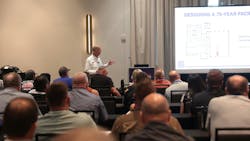
Several years after introducing the concept of designing a facility capable of lasting 75 years, is getting attention. This May, the conference program on building for 75 years had standing-room-only. The strategies for durability, reduced maintenance, and long-term value were explained and offered. Federal grant funding, while uncertain, remains an essential avenue, and departments must understand the complexities of the process and the importance of cultivating political support.
With over 60 programs, the 2025 Station Design Conference provided guidance on emerging technologies, including electric fleets, drone operations, robotics, and artificial intelligence-based security systems. The integration of artificial intelligence and consolidation of multiple NFPA training standards into NFPA 1400 signal substantial changes ahead for both training facilities and operational stations. First-timers to the design process learned the basics of starting a fire station project, including developing their department’s program, conducting a needs assessment, developing delivery methods, and developing requests for proposals/requests for quotes.
Obviously, a significant concern is the rising construction costs, driven by shortages of skilled trades, higher material costs, stringent code requirements for essential facilities, and the specialized nature of fire station operations. Increasing fire department responsibilities requires additional spaces: EMS, hazmat, technical rescue, and joint operations all require dedicated storage, training, and decontamination areas. In addition, the focus on firefighter physical and mental health continues to gain momentum, reinforcing the separation of contaminated and living areas.
Last month, we wrote about what is “wrong” with so many existing fire stations. Aging buildings, deferred maintenance, inadequate layouts, and a lack of storage space create a long list of costly deficiencies. Departments need to determine whether renovation is possible or whether replacement is a better long-term investment.
Station Design Conference provides answers
The annual Station Design Conference remains the leading forum for navigating fire station decisions. It offers multiple tracks on facility planning, delivery methods, operations, the integration of emerging technologies, and the increasing interest in shared first responder facilities.
The 2025 conference had a consistent message: modern fire stations must be designed with health, safety, resilience, and longevity at the forefront. Achieving these goals requires preparation, expertise, and a commitment to building facilities capable of supporting the expanding mission for the years ahead.
The 2026 Station Design Conference, May 18-21, will be held in Reno, NV. The conference will offer over 60 presentations specifically for fire and police chiefs, department officials, and city managers who are planning or building fire, law enforcement, or public safety facilities. Registration is now open too!
About the Author
 Janet A. Wilmoth
Janet A. Wilmoth
Special Projects Director
Janet Wilmoth grew up in a family of firefighters in a suburb of Chicago. Wilmoth, who is owner of Wilmoth Associates, worked with Fire Chief magazine for 27 years until it closed in 2013. She currently is the project director for Firehouse, overseeing the Station Design Conference.